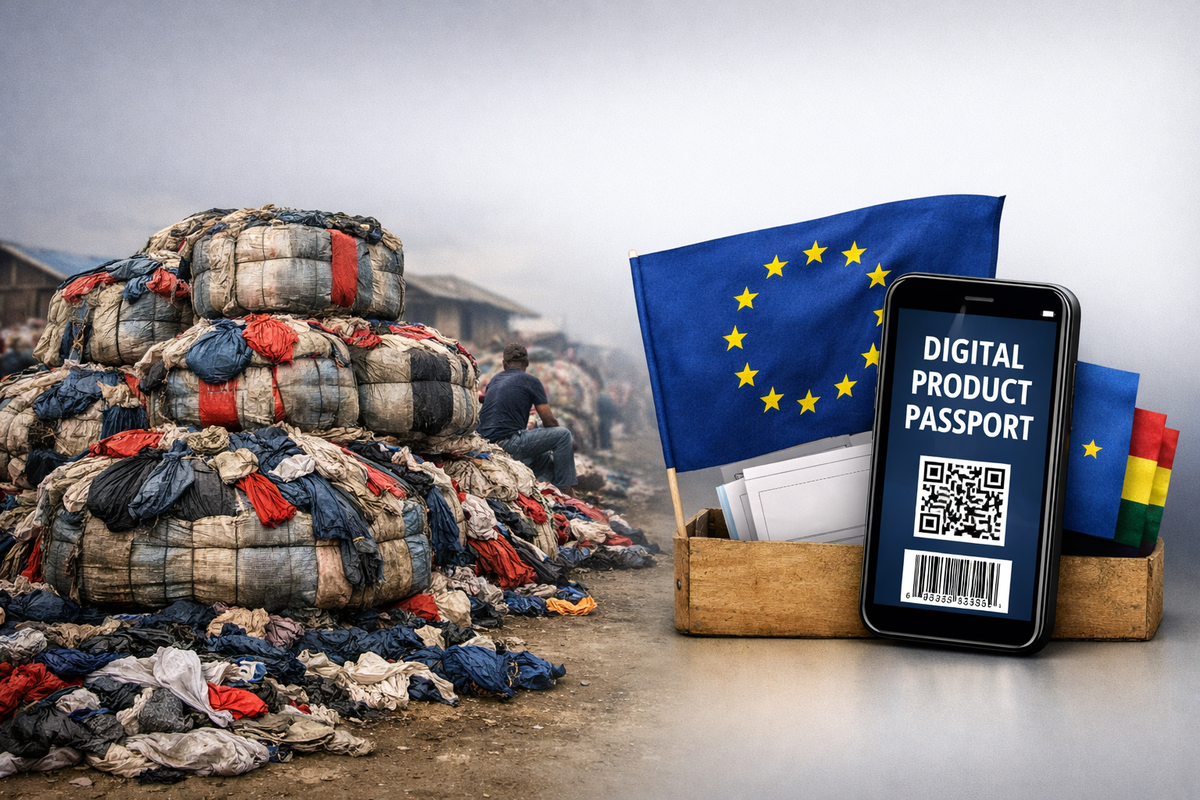
In Ghana, container ships dock at Tema Port and distribute what has become one
of global fashion's most visible contradictions. Inside Kantamanto Market,
spanning 18 acres and considered the world's largest secondhand clothing hub,
roughly 15 million garments arrive weekly, sorted and resold by traders whose
entire livelihoods depend on goods they have never seen. Each bale is bought
without inspection, previews, returns, or recourse.
When the bale is opened, the gamble concludes, and more often than not, market women end up on the losing side.
Approximately
40% of arriving garments are unsellable: torn, chemically degraded, or
manufactured from synthetic fibres wholly unsuited to Accra's tropical climate 1. Daily, over 100 tonnes of unwanted
clothing are dumped into drainage channels, informal landfills, and shorelines
adjoining the Korle Lagoon, a body of water documented as Ghana's most polluted
water on earth. A Greenpeace Africa investigation detected benzene and other
carcinogens in air samples from washhouses where rejected garments are burned 2. In just one year, the United Kingdom exported 57,000
tonnes of fashion waste to Ghana, making it the second-largest destination
after the UAE 3.
What has received far less attention in this global conversation is a fundamental question of information asymmetry: not what arrives in Ghana, but what anyone knows about it before it does.
The
Transparency Gap
Kantamanto’s
traders, mostly women and many using borrowed funds, buy bales without any
information on fibre content, chemical compliance, durability, or the brand of
origin. A “Grade A” classification assigned by an overseas exporter may still
yield up to 50% unusable items: bloodstained, structurally degraded, or
otherwise unsaleable. When the contents fail to meet expectations, traders bear
the loss and discard the waste onto the street. Ghana’s secondhand clothing
industry provides around 2.5 million jobs and contributes $200 million to the economy 4.
However, its core commercial transaction, the bale purchase, is carried out completely without product-level data.
This
represents more than just a logistics failure; it is a data failure, something
Europe is currently developing tools to address, even if Ghana is not yet a
focus.
The
Digital Product Passport: What It Is and What It Carries
The
EU's Ecodesign for Sustainable Products Regulation (ESPR), which entered into
force in July 2024, introduces the Digital Product Passport (DPP) as a
mandatory digital record for all textile products sold in the European market.
The textile-specific Delegated Act is scheduled for 2027, with a compliance
window extending implementation into 2028–2029 5. Phase 1 requirements cover fibre composition, country
of manufacture, chemical compliance status, and certifications; Phase 2 extends
to carbon footprint and water consumption data 6. The DPP is accessed via a QR code or an NFC
chip embedded in the garment's care label, and, by assigning a unique digital
identity to each product, it enables traceability from the raw material origin
through the supply chain to the point of sale.
In
the European Commission's own framework, the DPP is designed to serve not only
retail consumers but also regulators, sorters, and recyclers across the full
value chain. That value chain extends far south of Brussels.
DPP
as a Pre-Export Quality Gate for Ghana
A
DPP-equipped garment entering the secondhand clothing stream would carry a
verifiable, scannable record: fibre content, durability indicators, and
chemical compliance status. At Kantamanto or Tema Port, this data enables
importers and Ghanaian customs to verify bale contents prior to purchase or
clearance, and to refuse chemically non-compliant stock at the border. Ghana's
nascent Extended Producer Responsibility (EPR) framework, currently in
legislative development, would gain a technological backbone rather than
relying on unverifiable exporter declarations. Policy analysts consider
cross-border EPR rules, which align financial liability with brand design
choices, essential to clarify and enforce Kantamanto's waste economics.
The
Displacement Risk the EU Cannot Ignore
There is, however, an urgent parallel concern. As ESPR raises minimum quality thresholds for goods sold in Europe, brands face commercial pressure to accelerate the export of near-compliant or below-standard stock to markets without equivalent regulatory floors. Nearly 54,000 tonnes of used clothing already flow from EU countries to Ghana each year, according to 2023 Eurostat/Comtrade data 7, and that is before ESPR's textile provisions take full effect. The post-enforcement figure could be substantially higher unless DPP data is explicitly extended to goods entering the secondhand export stream. The African Union has begun continental EPR discussions; a mutual recognition arrangement in which DPP compliance is a precondition for legal secondhand textile export is both technically feasible and politically necessary.
What must happen
For
the DPP to deliver benefits beyond Europe, three conditions are necessary.
First, passport data must remain accessible throughout the second-hand export
chain rather than disappearing once products leave European markets. Second,
importing countries such as Ghana should be granted access to relevant product
information through customs and regulatory systems. Third, DPP implementation
should be complemented by cross-border Extended Producer Responsibility
mechanisms that align the costs of waste management with the actors responsible
for product design and market placement. Without these measures, transparency
risks documenting waste rather than preventing it.
Conclusion
The Digital Product Passport was designed with
European consumers and regulators in mind, but its greatest value may lie
beyond Europe's borders. Extending its reach to the secondhand export stream
would cost the EU little beyond political will, yet it could give Ghana's
traders, regulators, and recyclers something they have never had verifiable
information about what is arriving before it arrives. That single shift, from
blind trust to shared data, is what separates a policy that merely manages
waste from one that helps prevent it.
The bale will be cut open either way. The question is whether anyone will know what's inside before it leaves.