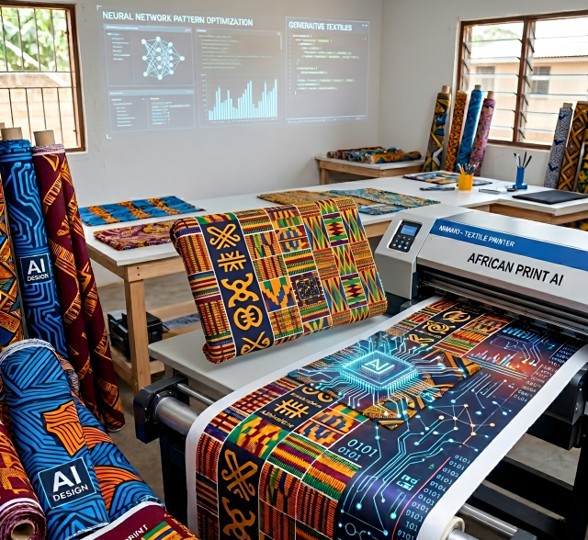
African print fabrics, known for their vibrant colours, symbolic motifs, and cultural depth, have historically served not only as aesthetic fabrics but also as powerful carriers of identity, history, and social meaning. These textiles have become central to cultural expression across the African continent and the world at large. The application of AI in African print design presents fresh opportunities for innovation while simultaneously raising critical concerns about cultural preservation and ethical practice amid rapid digital transformation.
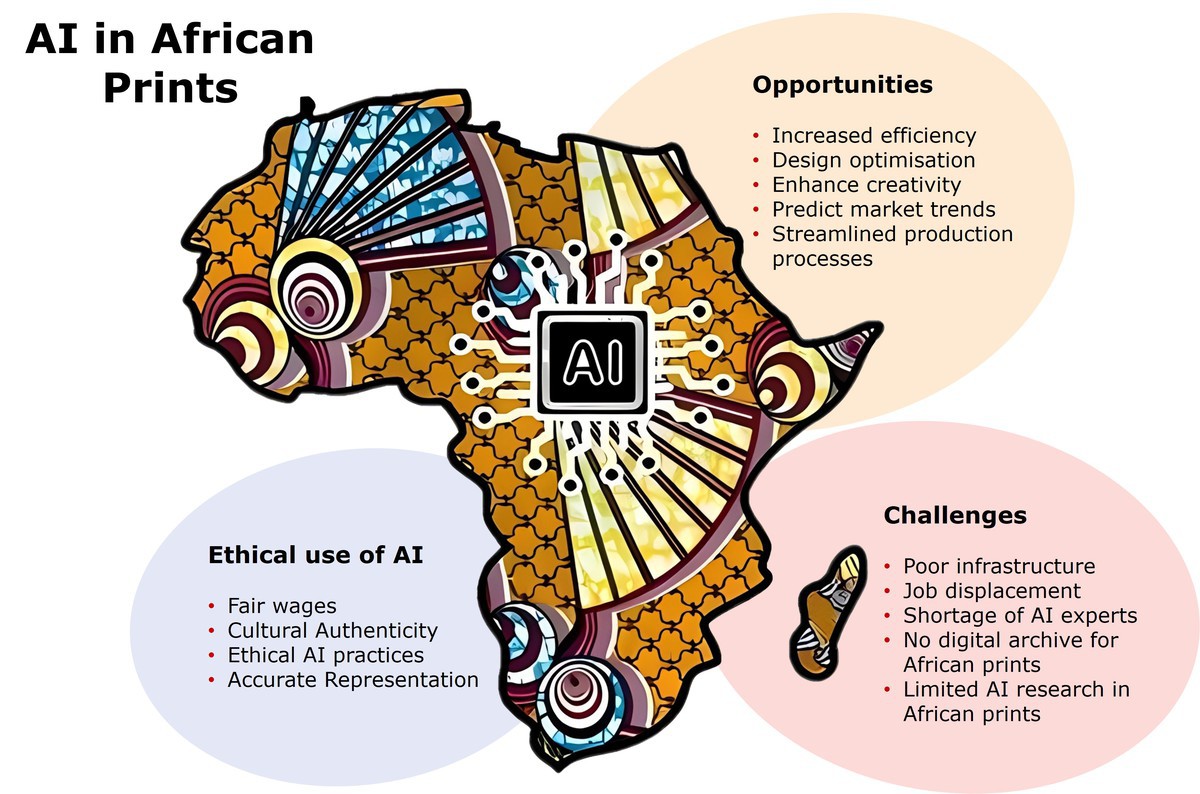
In our recent study, it was revealed that AI technologies, especially machine learning, generative design systems, and pattern recognition algorithms, have reshaped the concept of textile design and its production. For example, AI tools, such as AI-driven predictive analytics, can forecast consumer preferences, colour trends, and market demand, thereby enhancing the precision of design decisions and reducing the risks associated with overproduction. These advancements suggest that AI has the potential to significantly improve efficiency within the textile production cycle.
Key benefits
Beyond
efficiency, AI introduces new paradigms of creativity through collaborative
design processes. Rather than replacing human designers, AI functions as a
co-creative agent, augmenting human imagination with computational
capabilities. Designers can use AI tools to generate different designs, refine
motifs, and explore innovative interpretations of traditional patterns. This
interaction fosters a dynamic relationship between technology and creativity,
enabling the production of culturally inspired yet contemporary textile
designs. Additionally, AI promotes mass customisation by assessing individual
customer preferences, enabling the creation of customised garments and fabrics.
Another significant area where AI shows great
potential is sustainability. The textile
industry has long been associated with high levels of material waste and
environmental impact. Digital prototyping and virtual simulation are two
AI-driven technologies that eliminate the need for physical prototypes during
the design stage. By creating digital replicas of fabrics and garments,
designers can test and refine their ideas without excessive material
consumption. Similarly, AI-enabled production methods, such as on-demand
manufacturing and 3D printing, contribute to waste reduction by ensuring textiles
are produced only as needed. These developments enable the fashion industry to shift
to more resource-efficient, sustainable production methods.
Key Challenges
Despite
the advantages mentioned above, AI application in African print design is
associated with significant challenges. Maintaining cultural authenticity is
one of the most important issues.
African prints are deeply embedded with symbolic meanings that represent
historical narratives, social values, and communal identities. Because AI
systems rely on data-driven learning, they cannot possess the contextual
awareness necessary to accurately evaluate and replicate these cultural
components. As a result, the cultural value contained in traditional patterns
may be diluted or misrepresented by AI-generated designs. This raises vital
questions about the extent to which technology can engage with intangible
cultural heritage.
Closely
related to this issue is the problem of cultural appropriation. The global
fashion industry has historically been characterised by the unregulated use of
African-inspired designs by external entities, often without proper attribution
or compensation. This problem might be made worse by AI technologies' ability
to scale, which allows culturally significant patterns to be quickly replicated
and commercialised. It can be predicted that, in the absence of suitable
legislative frameworks, African communities and designers risk being even more
marginalised within global value chains and losing sovereignty over their
cultural assets.
Another
significant barrier to AI adoption in African textile industries is the lack of
infrastructure and technical expertise. Effective AI implementation requires
access to high-quality datasets, advanced computational resources, and skilled
professionals in fields such as data science and machine learning. However,
many African countries face challenges related to limited digital
infrastructure, insufficient funding, and a shortage of skilled professionals
in AI and data science. These constraints are particularly pronounced among
small and medium-sized enterprises, which constitute a significant portion of
the textile sector. As a result, the benefits of AI may be unevenly
distributed, potentially widening the gap between technologically advanced
firms and traditional producers.
The Future
Despite these obstacles, there is promising evidence of AI integration in the African textile industry. Companies such as Tex Style Ghana Limited have begun using AI to analyse consumer preferences, predict market trends, and develop culturally relevant designs that appeal to both local and international audiences. These projects demonstrate how AI can enhance competitiveness while preserving cultural identity by blending traditional patterns with contemporary design features.
Looking ahead, the successful integration of AI into African print design will depend on achieving a delicate balance between innovation and cultural preservation.
Collaborative approaches that involve designers, technologists, and cultural experts are essential to ensure that AI systems are developed with sensitivity to local contexts. Furthermore, policy frameworks and ethical guidelines must be established to protect cultural heritage and ensure fair recognition and compensation for traditional knowledge.